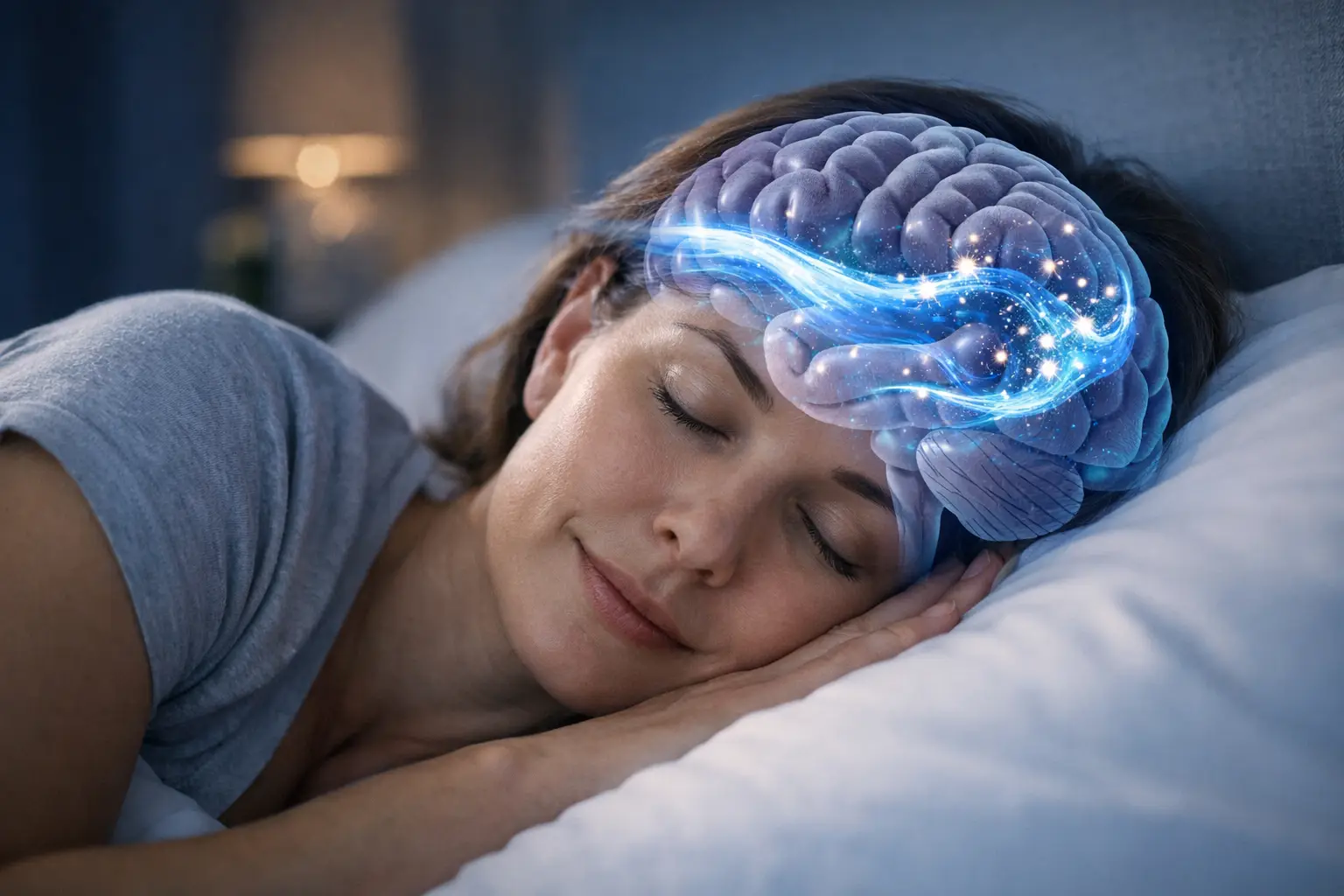
How Nighttime Brain Cleanup Works During Deep Sleep
A night of shallow, interrupted sleep can leave more than dark circles behind. It may also reduce the time your brain has for one of its most essential maintenance jobs: moving metabolic waste out of its tissue. Understanding how nighttime brain cleanup works changes the way we think about sleep. Sleep is not passive downtime. It is a biologically active recovery period when the brain shifts resources toward restoration, circulation, and clearance.
How nighttime brain cleanup works
Your brain does not have conventional lymphatic vessels running through its tissue the way many other parts of the body do. Instead, it relies on a specialized fluid-clearance network called the glymphatic system. This system uses cerebrospinal fluid, the clear fluid surrounding the brain and spinal cord, to help wash through spaces around blood vessels and carry waste away.
Think of it as a fluid-exchange process. Cerebrospinal fluid enters channels around arteries, moves through brain tissue, and exchanges with fluid between brain cells. Along the way, it can help collect metabolic byproducts generated by constant neural activity. That fluid then moves toward drainage pathways that connect with the body’s broader lymphatic and circulatory systems.
This process matters because the brain is metabolically demanding. Even while you sit quietly, billions of cells are signaling, using energy, and producing waste. Some proteins associated with neurodegenerative disease, including beta-amyloid and tau, have been studied in connection with sleep and glymphatic clearance. Researchers are still defining exactly how these relationships work in humans, but the central message is already clear: consistently poor sleep is not just a daytime energy problem.
Deep sleep is the brain’s prime maintenance window
The glymphatic system appears to be especially active during deep non-REM sleep, also called slow-wave sleep. This is the stage many adults lose as they get older, and it is often disrupted by sleep apnea, chronic stress, alcohol, pain, medications, irregular sleep schedules, and frequent nighttime waking.
During deep sleep, brain activity becomes slower and more synchronized. At the same time, changes in blood flow and cerebrospinal fluid movement may create a stronger rhythmic exchange of fluids through the brain. In animal research, the spaces between brain cells have also been observed to expand during sleep, potentially allowing fluid to move more freely.
That does not mean the brain suddenly turns into a pressure washer at midnight. Human glymphatic research is complex, and scientists are still working out which mechanisms matter most, how much clearance occurs during different sleep stages, and how these processes differ from person to person. But the pattern is compelling: deep, consolidated sleep appears to create conditions that favor brain recovery and waste movement.
For someone who wakes every hour, spends little time in deep sleep, or has untreated breathing disruptions, the issue may not be simply getting enough hours in bed. The quality and continuity of those hours may determine whether the brain gets the recovery window it needs.
The cells and pulses behind glymphatic flow
The glymphatic system is not a single pipe. It is a coordinated system shaped by brain cells, fluid channels, blood vessels, and sleep-related rhythms.
Astrocytes, star-shaped support cells in the brain, play a major role. Their specialized end-feet surround many blood vessels and contain water channels known as aquaporin-4, or AQP4. These channels are thought to help regulate water movement between fluid spaces and brain tissue. When AQP4 is properly organized around blood vessels, fluid exchange may be more efficient. Aging, inflammation, traumatic brain injury, and vascular changes may interfere with this organization.
Blood vessel pulsation also appears to help drive fluid movement. Every heartbeat, breath, and wave of vascular activity creates subtle mechanical forces. During restful sleep, the timing of neural activity, blood flow, and cerebrospinal fluid movement may become particularly favorable for clearance.
This is why brain health cannot be reduced to one nutrient, one sleep gadget, or one perfect bedtime. Glymphatic function sits at the intersection of sleep architecture, circulation, inflammation, brain injury history, metabolic health, and daily habits. A person with insomnia and high blood pressure may face a different set of obstacles than someone recovering from a concussion or living with long COVID brain fog.
What gets in the way of overnight brain recovery
Sleep apnea deserves special attention. Repeated drops in oxygen and frequent micro-awakenings can fragment deep sleep, increase stress signaling, and strain the cardiovascular system. Many people with apnea do not realize they have it. Loud snoring, gasping, morning headaches, dry mouth, excessive daytime sleepiness, and waking unrefreshed are reasons to discuss screening with a qualified clinician.
Alcohol is another common disruptor. It can make falling asleep feel easier, yet it often fragments the second half of the night and suppresses or alters restorative sleep patterns. The same trade-off can occur with late-night heavy meals, intense emotional stimulation, and inconsistent sleep timing.
Brain injury and chronic inflammation may add further challenges. After a concussion or traumatic brain injury, sleep changes are common, and researchers continue to investigate how injury affects glymphatic pathways. Migraine, depression, vascular disease, and neurodegenerative conditions can also overlap with poor sleep and cognitive symptoms. These connections do not mean that sleep loss alone causes a specific disease. They do mean sleep deserves to be treated as a serious part of long-term neurological resilience.
Supporting the conditions for glymphatic function
There is no proven shortcut that replaces deep sleep. The most useful approach is to protect the biological conditions that allow nighttime clearance to occur.
Start with consistency. A stable wake time helps anchor your circadian rhythm, which makes it easier for the brain to build sleep pressure and enter restorative stages at the right time. Aim for a dark, cool room and give yourself a real wind-down period rather than moving directly from work, news, or social media into bed.
Address breathing early. If you suspect sleep apnea, do not dismiss it as ordinary snoring. Proper evaluation and treatment can improve far more than nighttime comfort. It may protect oxygen delivery, cardiovascular health, daytime cognition, and the continuity of your sleep cycles.
Protect your evenings. Limit alcohol close to bedtime, keep caffeine earlier in the day if you are sensitive, and avoid turning late-night meals into a daily habit. Regular daytime movement can support sleep quality, but very intense exercise immediately before bed may keep some people too alert. The right timing depends on your body.
Support the fundamentals that influence blood vessels and inflammation: nourishing food, blood sugar management, hydration, stress regulation, and medically appropriate treatment for blood pressure or other conditions. These are not glamorous interventions, but the glymphatic system depends on the health of the terrain around it.
For adults looking for a natural, glymphatic-focused addition to a broader brain-health routine, My Brain Restore™ was created around a rare plant seed preserved with Ultra Chill Milled™ technology. It is designed to support the body’s natural glymphatic-system activity, not to substitute for sleep, medical care, or treatment for neurological disease.
A smarter way to measure sleep success
Do not judge your sleep only by total hours. Eight fragmented hours can feel very different from seven and a half continuous hours with meaningful deep sleep. Notice how you function in the morning. Do you wake clear-headed? Are you relying on repeated caffeine doses to think? Is brain fog becoming normal? Are you forgetting words, names, appointments, or why you entered a room more often than before?
These signs are not a diagnosis, and they can arise from many causes, including medication effects, thyroid issues, mood disorders, nutrient deficiencies, and sleep disorders. Persistent or worsening cognitive changes deserve professional attention, especially after a head injury or when accompanied by balance changes, severe headaches, weakness, speech difficulty, or confusion.
The bigger opportunity is to stop treating sleep as negotiable. Every protected night gives your brain another chance to perform the quiet work it was built to do. Build a routine that defends deep sleep, investigate the problems that repeatedly interrupt it, and let your brain’s overnight maintenance crew have the time it needs.